what hypotheses have been proposed to explain the demise of the dinosaurs?

What Killed The Dinosaurs?
EXTINCTION THEORIESTwo main camps be in paleontology today, each having a different view of what killed the dinosaurs and other organisms at the K-T boundary. Controversy has surrounded the topic since 1980; it has become difficult for the public (and the scientific world at large) to understand the issue due to the tangled assemblage of data which seems to point in many different directions. Luckily, the controversy has not harmed the study of mass extinction causation, but rather has made it a dynamic and interesting surface area. Every groundbreaking new hypothesis makes new headlines in the media, and excites researchers to delve further into the mystery.
The major sides of the schism tin can be broken down (profoundly simplifying the issue, simply making it more accessible) into "intrinsic gradualists" and "extrinsic catastrophists." We'll describe each generalized group in turn, and so try to synthesize the bachelor information so you can form your ain opinion. But offset, let's outline what scientists generally hold that we know near the K-T purlieus.
The common ground
- There was global climate change; the environment changed from a warm, mild one in the Mesozoic to a libation, more varied one in the Cenozoic. The cause of this climate change, and the speed at which it proceeded, are the major concerns of both schools of thought.
-
Equally well equally a permanent global climatic modify, there is evidence that there were less lasting changes at the end of the Cretaceous flow. These changes may accept been the result of a massive terrestrial disturbance, which threw upward soot into the air, causing short term acid rain, emission of poisonous gases, and cooling (like to a nuclear winter). Long term consequences would take been a global greenhouse outcome (warming and reduced sunlight).
-
Every bit discussed before, many organisms; both marine and terrestrial, vertebrate and invertebrate; went extinct. The reason for this extinction was probably this climate change.
-
At or near the K-T boundary in several places around the globe, we have a thin layer of dirt with an unusually high iridium (a rare metal similar to platinum) content. This may be testify for the dust cloud in #two above.
The "intrinsic gradualists"
Those scientists falling into this category believe that the ultimate cause of the Yard-T extinction was intrinsic; meaning of an Earthly nature; and gradual, taking some fourth dimension to occur (several one thousand thousand years). Ii main hypotheses exist today:
- Volcanism: We are quite certain that the end of the Cretaceous catamenia that there was increased volcanic activity. Over a period of several meg years, this increased volcanism could have created enough grit and soot to block out sunlight; producing the climate change. In India during the Late Cretaceous, huge volcanic eruptions were spewing forth floods of lava which tin exist seen today at the 1000-T boundary (these ruptures in the Earth's surface are chosen the Deccan traps). The chemical composition of the lava rocks in India shows that they originated in the Earth's drape, which is also relatively rich in iridium. This richness would explain the iridium layer.
-
Plate Tectonics: Major changes in the organization of the continental plates (continental drift) were occurring at the Thousand-T boundary. The oceans (especially the Interior Seaway in N America) were experiencing a regression; they were receding from the land. A less mild climate would have been the outcome, and this would accept taken a long time. Large scale tectonic events did occur in the Mesozoic several times, and no extinction events have been conclusively associated with them withal.
Note that these 2 above hypotheses are inextricably tied together; volcanism cannot occur without the action of plate tectonics, and vice versa. If the extinction was intrinsic and gradual, both processes probably played a part. Also annotation that the bones theory here is an elaboration of the 'dinosaurs faded away' hypothesis from the invalid hypotheses section; it adds a cistron of causation that is quite convincing.
The "extrinsic catastrophists"
This side of the controversy holds that the ultimate crusade of the Grand-T extinction was extrinsic, meaning of an extraterrestrial nature, and catastrophic, meaning fairly sudden and punctuated. The chief hypothesis was proposed in 1980 by (amongst others) Luis and Walter Alvarez of the Academy of California at Berkeley.
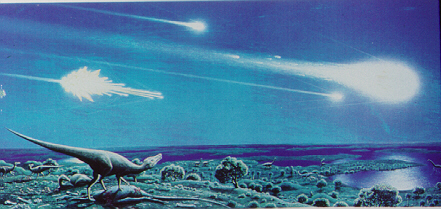
The Alvarez Hypothesis: The original hypothesis is the footing for several subsequent variations on the theme that a large extraterrestrial object collided with the Earth, its affect throwing up enough grit to cause the climatic change. The iridium layer is what prompted the Alvarez squad to blame an asteroid bear on for the extinction — asteroids and similar extraterrestrial bodies are higher in iridium content than the Earth's crust, so they figured that the iridium layer must exist equanimous of the grit from the vaporized meteor. No crater was establish, but information technology was assumed that one existed that was nigh 65 million years old and 100 kilometers (most 65 miles) in diameter.
After research found a likely candidate for the crater at Chicxulub, on the Yucatan Peninsula of Mexico. Other testify was also reported: the presence of shocked quartz in the rocks of the Thou-T purlieus (indicating the passage of a shock wave then powerful that it actually rearranged the crystal structure of quartz grains), glassy spheres that looked like impact ejecta (molten stone that solidified into droplets when cooled), and a soot layer was found in many areas (bear witness for widespread forest fires). The likelihood that massive hurricanes and firestorms would have raged beyond the World was likewise hypothesized, calculation to the subversive power of the catastrophe.
To reconcile the hypothesis with gradual data, it was suggested that rather than one impact, several impacts (of comets or meteors) could accept occurred over a period of many years. Some testify supported this — a hint of periodicity of mass extinctions in the fossil record was reported; mass extinctions seemed to occur roughly every 26 million years. Astronomers theorized that the Oort cloud of comets could cantankerous the path of our solar system every 26 meg years, and would possibly pelting comets on our planet for a few one thousand thousand years. The beingness of a tenth, as-yet unseen planet — or Nemesis, the twin star to our sun — both with big orbits were besides contemplated. To engagement, no reliable bear witness for periodicity or Nemesis-type angelic bodies has been found, just this does non render the hypothesis obsolete; information technology is accepted that any large extraterrestrial body impacting the Earth's surface could and would produce climatic changes similar to those thought to have occurred effectually the K-T purlieus.
All of this work was non without its detractors, of grade; we'll discuss that in the final department.
Conclusions?
There has been no settlement to the issue and so far, and no clear one is foreseeable. Both sides claim to hold the majority of proponents in science; it seems that (greatly over-generalizing) many paleontologists lean towards the intrinsic side, while many astronomers and physicists favor the extrinsic side, and geologists are probably evenly split between the two.
All of the evidence cited for the extrinsic catastrophist side is claimed as testify by the intrinsic gradualists for their side or against the contrary side — volcanoes could create the iridium layer, shocked quartz, soot, and impact ejecta; the makeup of the iridium layer is not uniform in all areas, so it could exist meaningless; so on.
The principal problem with both hypotheses is the issue of the selectivity of the mass extinction; equally yous saw before in the background department, some organisms were wiped out, while others were unaffected. Can climate change really explicate the differential selectivity of the Grand-T event? Our lack of understanding of the physiology of dinosaurs makes the outcome more complex; if they were endothermic, why did they not survive like birds and mammals? If they were ectothermic, why did small dinosaurs non survive like modest reptiles?
Also, many studies have focused on the extinction of dinosaurs alone, and have forgotten about the more substantial marine ecosystem collapse. The fossil record suggests that some marine reptiles died out several one thousand thousand years prior to the M-T purlieus.
Other major issues with the upshot are that it is non like shooting fish in a barrel to prove (exam) causation (as noted before), and that nearly of the ages of the rocks that dissimilar evidence comes from are questionable. It is not certain whether there is a gradual turn down in the global fossil record, or if in that location was a sudden catastrophe; some studies in some areas show evidence pointing to unlike answers.
Ultimately, we just don't know yet for sure. The two main schools of thought are dissever fairly evenly amongst scientists familiar with them. Either an intrinsic or extrinsic cause for the extinction would take complex biotic effects on ecosystems which would await disruptive in the fossil record. At that place could well have been unlike, even divide extinctions in the oceans and on land; the marine fossil record does back up a slightly rapid turn down, while the terrestrial record (particularly in North America) strongly suggests a more gradual decline (but once again, has a bitty fossil record). If an extraterrestrial touch on occurred during a gradual refuse, that might explain the seemingly contradictory evidence. If you are looking for an opinion hither from a paleontologist's point of view, it seems that the simplest explanation is that the climatic changes induced by the shifting continents and the regression of the continental seaways were the ultimate cause (at least in Due north America), but this has not been (and may not ever be) proven. There is much work to exist done, and much value to this work — understanding the K-T extinction would help united states of america to empathise mass extinctions in general, and might provide a glimpse into the fleeting, evanescent nature of our own mortality.
Explore the Result:
Invalid Hypotheses
Return to Background Info
Dorsum to DinoBuzz
Learn more about the Dinosauria


Source: https://ucmp.berkeley.edu/diapsids/extinctheory.html
0 Response to "what hypotheses have been proposed to explain the demise of the dinosaurs?"
Post a Comment